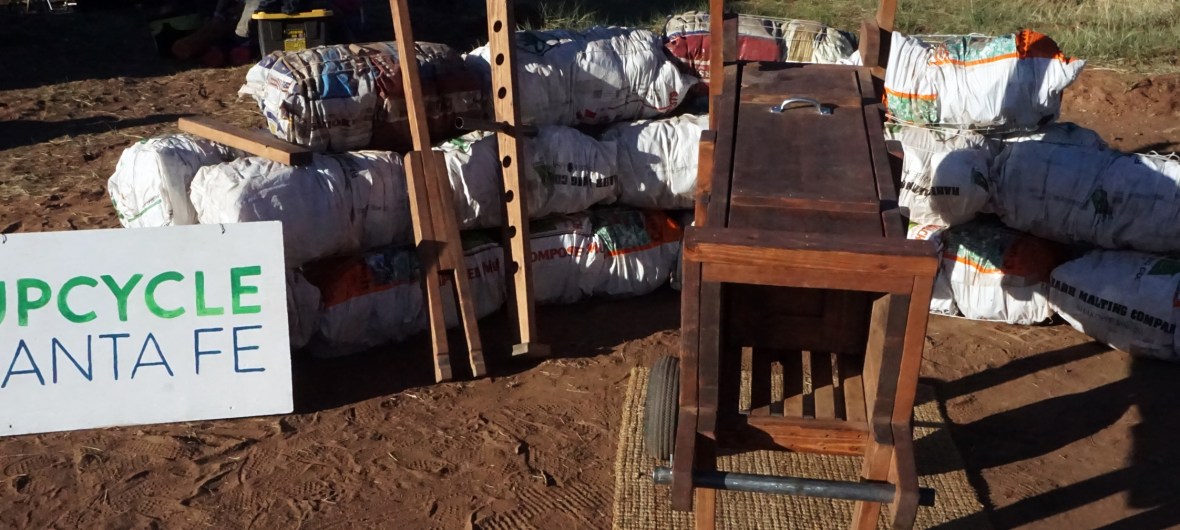

Ecobales, otherwise known as Ubuntu-Blox, are the most important method of upcycling plastics that we advocate for and encourage the adoption of. The reason is that Ecobales can be made with every type of plastic, and thus can be used as a catch-all and one-stop solution for dealing with the entirety of a community’s plastic waste stream.
Ecobales were originally made exclusively with shredded and bagged Styrofoam (EPS), with the thinking being that these materials would offer the best insulation quality. They probably do (donate to our continued research!), but the need for a simple yet comprehensive plastic recycling solution drove us in 2015 to start making them with every type of plastic that we collected.
Ecobales need to be further tested (R-Value and Flame Spread) for usage in residential construction here in the USA. Currently they can be used for all sorts of other constructions though, including exterior walls, or smaller storage buildings where a good amount of insulation is needed. We are working on sharable designs for the Ecobale Press, but in the meantime if you would like to build your own please send us an email and we will do our best to assist you!

A BRIEF HISTORY
Ecobales / Ubuntu-Blox are dense bales of bagged and compressed post-consumer plastic or Styrofoam waste that are made using the open-source Ecobale Press. This baling and building system was originally developed by inventor Harvey Lacey in Texas, USA and tested in Haiti following the 2010 earthquake, where several structures were built using Styrofoam (EPS) Ecobales. Harvey later built a small and portable prototype structure that was tested for seismic resistance in Texas. His brilliant and revolutionary building system turns readily available materials (waste Styrofoam, shopping bags and twine or wire) into highly insulating bales that can then be stacked inside of a rebar and wire structural matrix to build highly earthquake-resistant walls and structures.
In the fall of 2014, after completing and testing his first wooden Ubuntu-Blox press (previous presses were made of metal), Harvey came to Santa Fe for a workshop with us. Together with Only Green Design we built a new, bigger compression machine made from reclaimed pallet wood, and transformed about 3 cubic meters of EPS foam into a new outdoor wall at the local Earth Nurse community.


Due to a plastic shopping bag ban here in Santa Fe, we had to make several trips to a collection point in Espanola to get enough bags to make all the Ecobales we needed for the wall. We had to find a better bag solution for making Ecobales. Luckily, a friend came over one day with some 2-cubic foot compost bags that fit perfectly in the bigger, reclaimed press that we made with Harvey (we now use 2-cubic foot woven poly feed and malt bags as they are a bit stronger). We also decided to make not only Styrofoam Ecobales, but ones stuffed with all sorts of mixed soft, hard and foam plastic waste. These mixed plastic Ecobales offer a great long-term solution for the entirety of the plastic waste stream.
VIDEO RESOURCES:
Moab Ecobale / Ubuntu-Blox Project 2018:
How to Build an Ubuntu-Blox Machine:
Building with Ubuntu-Blox Workshop Videos:
Harvey Lacey in Haiti:
National Technical Systems 7.0 Earthquake Test:
 PLAN FOR PLASTIC